
The Clip of Rahat Fateh Ali Khan-Qalam Uthao Sathio Ye He Farz Ki Pukar,Dhati Dharti Apni Man.


The Clip of Rahat Fateh Ali Khan-Qalam Uthao Sathio Ye He Farz Ki Pukar,Dhati Dharti Apni Man.
 With its colourful plumage in red, black, yellowish brown and white, the grey phalarope is a fascinating wader. The female is the largest and most colourful of the sexes. The male incubates the eggs and rears the young. Meanwhile, the female may mate with other males and lay another clutch of eggs in a new nest. Watching the grey phalarope is a great pleasure, as it swims about in small ponds kicking up prey items (insect larvae and crustaceans) with its feet. In Svalbard the grey phalarope breeds in pairs or in small colonies throughout most of the archipelago. They migrate south starting in mid-July.

The Svalbard rock ptarmigan is the largest terrestrial bird overwintering in Svalbard and is widespread in most of the archipelago. Greatest densities are found in central areas of Spitsbergen where plant production is highest. The Svalbard rock ptarmigan is an endemic sub-species of rock ptarmigan. The male (cock) establishes a territory in March–April, which it protects through creating a diversion and making a burping sound. Males can often be spotted sitting on a rock or high ground guarding its territory. The female (hen) lays the 9-11 eggs within the territory. As soon as the chicks are hatched, they leave the nest and start wandering about. They are capable of flying after 10-12 days, but stay with the hen for another 10-12 weeks.

TODAY MOST OF US RUN THROUGH LIFE AT A RAPID PACE NEVER SLOWING DOWN TO LOOK AT THE BEAUTIFUL WORLD AROUND US.
I WAS INSPIRED BY A DREAM TO DO THIS COLECTION OF VIDEO’S FOR THOSE OF US WHOM NEED THE REMINDER TO STOP AND CHARISH THE WORLD IN WHICH WE LIVE.

The popular and beautiful Green-winged Macaw which is also known as Red-and-green Macaw of South America
is the most common of the large macaws in the wild. In recent years there has been a marked decline in its
numbers due to habitat loss and illegal capture for the pet trade. A Green-winged Macaw is a high maintenance
pet; it is expensive to purchase, adopt or maintain. It is also demanding, and extremely loud and noisy cage birds.
Flamingo Gardens. Davie, Florida. Here we have a pond full of Flamingos. I think the Flamingo is one of the most beautiful birds in the world. They look so graceful and have such a brilliant color.

 “The peacock is one of the most beautiful birds in the world.
We think of the peacock as a thoroughly masculine bird, proud,
showing of, flamboyant and aggressive. We accuse him of
strutting proudly, even referring to him when displaying as
being ‘in his pride’."
Here is a collection of 17 most beautiful birds in the world .


 About the names:1. Eurasian Bee-eater (Merops apiaster). Common bir in my zone. It nest in holes and feed sin insects. Migratory.2. Lilac-breasted Roller (Coracias caudata). As all rollers, it have magnificient colour. It's an African bird that feeds in insects.3. Eurasian kingfisher (Alcedo atthis) As many of the kingfishers it have delightful colours. It's a common bird in the rivers of my zone. It feeds in fishes.4. Chinese Green Magpie (Cissa chinensis). A very beautiful crow, from China. I never saw any alive only a stuffed specimen.5. Blue-footed Booby (Sula nebouxii). A tropical sea-bird that lives in big colonies and eat fishes.6. Monk parakeet (Myiopsitta monachus). A sociable parrot that makes very big communal nests. It's frost hardy, so, although originated from Argentina, now is widespread in many zones of the world. It's very common in my city. Feeds in fruits and seeds.7,8,9: I don't know what concrete species of white-eye is it. White eyes (genus Zosterops) are a very big genus with many, many species, most of them are very similar. I saw a pair of Japanese white-eyes (Zosterops japonica) caged in a street during a travel. They're tiny birds that feeds in insects an nectar from flowers.10: Hoopoe (Upupa epops). This species is very well known. Widespread in all the Old Wordl, modern taxonomist says that maybe could be considered three species of Hoopoe: the Eurasian (Upupa epops), the African (Upupa africana) and the Madagascan (Upupa marginata). But majority of people considere it as sole sub-species of the Hoopoe, the only member of the family Upupidae. It's a not rare bird, very unmistakable, partially migratory, it feeds in insects. The one of the photo is eating a Mole-cricket (Gryllotalpa sp.)


Do you know this joke where there’s one planet meeting another one?
And one says, “Hey, you really look terrible.”
The other planet says, “Yes, I know… I have Homo Sapiens…”
And the other planet says, “Oh yes, I know that. I had this before. But don’t worry, it will  disappear.”


Our Solar System is now made up of eight planets and their moons, three dwarf planets and moons, thousands of asteroids, comets and dust particles that orbit the Sun. Stars, like our Sun generate their own light while the other bodies shine by reflecting sunlight.
The word "planet" comes from the Greek word for "wanderer". All of the planets travel around the Sun in the same counterclockwise direction. The planets all rotate, or turn on their axes, as they travel around the Sun.
Every planet in our solar system has seasons. But the seasons that occur on other planets are extremely different from the traditional spring, summer, fall and winter weather that we experience here on Earth. On Earth, that tilt is the primary reason for the differences in weather we observe between summer and winter. Planets with smaller tilts might have smaller weather variations and planets with larger tilts could have more extreme variations.
Our orbit is nearly circular, so there is little variation in Earth's overall climate, averaged over both northern and southern hemispheres. But other planets have more elliptical orbits, and therefore their seasonal variations in weather are much different than ours.
Image : NASA 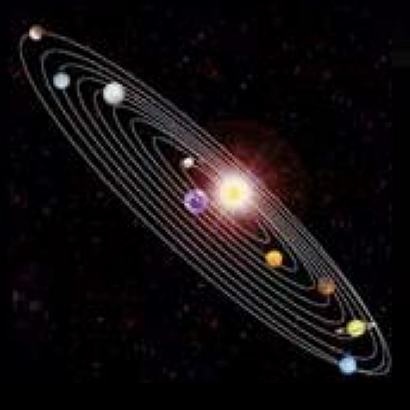
The researchers, led by Dr Giovanna Tinetti, an ESA fellow from the Institute d'Astrophysique de Paris and UCL (from 1st July), found that HD 189733b absorbs the starlight of its "sun", as it passes in front, in a way that can only be explained if it has water vapour in its atmosphere. This is the first time that astronomers have demonstrated for certain that water is present in an extra-solar planet with the infrared analysis of the planet's transit across its pa rent star providing the breakthrough.
Dr Tinetti, who is taking up a prestigious STFC Aurora Fellowship at UCL to study atmospheric signatures and biosignatures on planets beyond our solar system, said; "Although HD 189733b is far from being habitable, and is actually quite a hostile environment, our discovery shows how water might be common out there and how our method can be used in the future to study more life-friendly environments."
Dr Tinetti adds, "The 'holy grail' for today's planet hunters is to find an Earth-like planet that also has water in its atmosphere. That discovery, when it happens, will provide real evidence that planets outside of our Solar System might harbour life. So the discovery that water exists on an extra—solar gas giant is a vital milestone along that road of discovery."
This exciting discovery was made using NASA's Spitzer Earth-orbiting telescope, taking measurements at a number of key wavelengths in the infrared region of the spectrum that pick out the crucial signature of water. The water detection relied not only on Dr Tinetti's painstaking analysis, but also on the calculation of highly accurate water absorption parameters by Dr Bob Barber and Professor Jonathan Tennyson, also from UCL.
Dr Barber said, "Initial data included over 500 million individual absorption features and from this we calculated the absorption parameters. Each feature is unique, like a fingerprint, and provides vital clues about the amount of water present and the temperature of the atmosphere."
Professor Tennyson, who heads UCL's Physics and Astronomy Department, explained: "Parts of the atmosphere of HD 189733b are very hot – around 2000 degrees. You need the millions of lines we calculated to simulate this, putting in absorption accurately where it should be and – just as accurately – giving gaps for the light to get through the atmosphere, where it can."
Discover the cosmos! Each day we feature a different image or photograph of our fascinating universe, along with a brief explanation written by a professional astronomer.
 The Greeks named the sun Helios, but the Romans used the name Sol, which is still in use today. Due to the important role the sun plays in our lives, it has been studied, perhaps, more than any other object in the universe, outside our own planet Earth.
The Sun is the closest star to Earth. It is by far the largest object in the solar system, and contains more than 99.8% of the total mass of the Solar System (Jupiter contains most of the rest). Its strong gravitational pull holds Earth and the other planets in the solar system in orbit.
Our Sun is considered to be an average star, meaning its size, age, and temperature fall in about the middle of the ranges of these properties for all stars. It is only 4.6 billion years old. Some of its material came from former stars.
This image, "Handle-shaped Prominence", Extreme Ultraviolet Imaging Telescope (EIT) image of a huge, handle-shaped prominence taken on Sept. 14,1999. Prominences are huge clouds of relatively cool dense plasma suspended in the Sun's hot, thin corona. At times, they can erupt, escaping the Sun's atmosphere. Emission in this spectral line shows the upper chromosphere at a temperature of about 60,000 degrees K. The hottest areas appear almost white, while the darker red areas indicate cooler temperatures.
Let's head outward from the sun to the first planet in our solar system, Mercury.
By human standards, the Sun is eternal. It rises in the east every morning, sets in the west every evening, and shines brightly as it crosses the sky. Like all stars, though, the Sun undergoes constant change. Some of the changes take place over days or even minutes, others require decades, and still others require millions or billions of years.
The Sun was born about 4.6 billion years ago from the gravitational collapse of a vast cloud of gas and dust. Material in the center of the cloud was squeezed so tightly that it became hot enough to ignite nuclear fusion.
Today, the Sun continues to fuse hydrogen atoms to make helium in its core. It fuses about 600 million tons of hydrogen every second, yielding 596 million tons of helium. The remaining four million tons of hydrogen are converted to energy, which makes the Sun shine. Most of this energy is in the form of gamma-rays and X-rays. As the energy works its way to the surface -- a process that takes centuries -- it is absorbed by other atoms, then re-radiated at other wavelengths. When it reaches the  surface, where it can escape into space, most of the energy is in the form of visible light.
The motions of the hot gas below the Sun's surface create a powerful magnetic field. The field encircles the Sun with lines of magnetic force. These lines become entangled, forming relatively cool, dark magnetic storms on the Sun's surface known as sunspots. Occasionally, the entangled lines "snap," triggering enormous explosions of energy known as solar flares. Magnetic effects also pull out big streamers of hot gas from the Sun's surface, and they heat the Sun's thin outer atmosphere to more than one million degrees.
By human standards, the Sun is eternal. It rises in the east every morning, sets in the west every evening, and shines brightly as it crosses the sky. Like all stars, though, the Sun undergoes constant change. Some of the changes take place over days or even minutes, others require decades, and still others require millions or billions of years.
The Sun was born about 4.6 billion years ago from the gravitational collapse of a vast cloud of gas and dust. Material in the center of the cloud was squeezed so tightly that it became hot enough to ignite nuclear fusion.
Today, the Sun continues to fuse hydrogen atoms to make helium in its core. It fuses about 600 million tons of hydrogen every second, yielding 596 million tons of helium. The remaining four million tons of hydrogen are converted to energy, which makes the Sun shine. Most of this energy is in the form of gamma-rays and X-rays. As the energy works its way to the surface -- a process that takes centuries -- it is absorbed by other atoms, then re-radiated at other wavelengths. When it reaches the surface, where it can escape into space, most of the energy is in the form of visible light.
The motions of the hot gas below the Sun's surface create a powerful magnetic field. The field encircles the Sun with lines of magnetic force. These lines become entangled, forming relatively cool, dark magnetic storms on the Sun's surface known as sunspots. Occasionally, the entangled lines "snap," triggering enormous explosions of energy known as solar flares. Magnetic effects also pull out big streamers of hot gas from the Sun's surface, and they heat the Sun's thin outer atmosphere to more than one million degrees.
The shells result from eons of dynamic processes that began as the Earth formed. These processes, taken together, constitute global change. Without global change, we humans and much of the rest of the biosphere would not exist, because global change generated an oxygen-containing atmosphere, our protective stratospheric ozone layer, and global temperatures that support life (due to the greenhouse effect) as we know it. Until the last few thousand years, global change has been dominantly a "natural" process.
Recent observations have led scientists to conclude that human activities contribute to global change, that our industrial and land-management practices increase the rate of change of several geophysical phenomena, and that some changes may be deleterious to the biosphere. Nations around the world have banded together in a wide range of scientific and policy-based activities to determine the nature of human contributions to global change and to determine the effect such changes can have on our lives. These are gathered under the umbrella known as the International Geosphere-Biosphere Program (IGBP), which is, in essence, a massive effort to understand and learn to manage the world's environments.

As far back as the Apollo program, even before Landsat, scientists and others connected with the space program realized that earth-looking satellites, as their sensors improved, could provide a wealth of data and derived information about the Earth as a whole and about selected regions by operating in a coordinated way. Different spectral intervals, look angles, resolutions, etc. would provide complementary data sets useful in many applications. Thus, early on, the value of acquiring data from fleets of satellites was so compelling that planners began to devise programs that would supply such inputs. One variant would be to have different sensors on the same spacecraft. This next image was made as a composite using data supplied by land, meteorological, and oceanographic satellites that show clouds, land surfaces, and ocean water temperatures. It serves to introduce you to one of the main ideas in this Section: the Terra space platforms that bears five sensor systems which can gather data integrated spatially and in time which are invaluable in monitoring the Earth's natural systems and the impact of humans on such systems.
'Humans' is the keyword in the above paragraph. To the best of our knowledge, Earth is the only planet in the Solar System that supports life (although organic molecules may exist on one or more satellites of Jupiter and Saturn, and perhaps once on Mars [page 19-13]). Life, in all its myriad forms, virtually covers Earth. No matter where we look for it, we find it. Much of our planet's geophysical and biological phenomena take place in a relatively thin shell of fluid (the atmosphere and oceans) that is about as thin in proportion to the Earth as a sheet of paper wrapped around a basketball. Most other relevant life activities stay on the land surface,within an even thinner zone of the uppermost layers of soil and rock. And yet, the complex interactions between the biosphere and the geosphere all take place within that thin shell. Just about everything that concerns us as living beings depends upon the integrity of these shells of land, sea, and air.
As far back as the Apollo program, even before Landsat, scientists and others connected with the space program realized that earth-looking satellites, as their sensors improved, could provide a wealth of data and derived information about the Earth as a whole and about selected regions by operating in a coordinated way. Different spectral intervals, look angles, resolutions, etc. would provide complementary data sets useful in many applications. Thus, early on, the value of acquiring data from fleets of satellites was so compelling that planners began to devise programs that would supply such inputs. One variant would be to have different sensors on the same spacecraft. This next image was made as a composite using data supplied by land, meteorological, and oceanographic satellites that show clouds, land surfaces, and ocean water temperatures. It serves to introduce you to one of the main ideas in this Section: the Terra space platforms that bears five sensor systems which can gather data integrated spatially and in time which are invaluable in monitoring the Earth's natural systems and the impact of humans on such systems.
'Humans' is the keyword in the above paragraph. To the best of our knowledge, Earth is the only planet in the Solar System that supports life (although organic molecules may exist on one or more satellites of Jupiter and Saturn, and perhaps once on Mars [page 19-13]). Life, in all its myriad forms, virtually covers Earth. No matter where we look for it, we find it. Much of our planet's geophysical and biological phenomena take place in a relatively thin shell of fluid (the atmosphere and oceans) that is about as thin in proportion to the Earth as a sheet of paper wrapped around a basketball. Most other relevant life activities stay on the land surface,within an even thinner zone of the uppermost layers of soil and rock. And yet, the complex interactions between the biosphere and the geosphere all take place within that thin shell. Just about everything that concerns us as living beings depends upon the integrity of these shells of land, sea, and air.


